Monday, 16 September 2013
Australia II takes sailing's America's Cup
The America's Cup, a yacht sailing contest which had been in existence for over a century (to little publicity, at least in the UK) sprang into public consciousness in 1983, when the Australian vessel Australia II emerged as a serious contender for the trophy, defeating all challengers to take on the American holders, represented in 1983 by the Liberty vessel.
The trophy was named the America's Cup in honour of the schooner America, which won a race around the Isle of Wight in 1851 to take the trophy, presented by The Royal Yacht Squadron of the UK. Ever since, it had been in the possession of the New York Yacht Club (NYYC) and, so the story goes, the trophy was actually bolted in place at NYYC, so confident were they that they could defend it against any challenger.
Australia II, representing challengers the Royal Perth Yacht Club, and backed by businessman Alan Bond, boasted a winged keel design that had been kept a closely-guarded secret. The design was controversial since the NYYC had claimed that it was illegal under contest rules, however it had been ruled legal by the authorities, and the vessel easily qualified through the challenger series to become the contender to take on the NYYC vessel in the final contest. The speed of the Australia II in these challenges, coupled with its secret weapon keel design, aroused media interest which made this year's America's Cup one that attracted more publicity than ever before.
The final races themselves took place between September 14th and 26th, and it was the NYYC who took the first two with Liberty, before Australia II won the third race. Liberty won again to go 3-1 up in the series, but Australia II then won the fifth race and then the sixth, to take it to a deciding race. Until then, the series had never gone to even six races, let alone a deciding seventh. A closely-fought race with several lead changes ended with Australia II winning by 41 seconds to take the America's Cup and become the first successful challenger since that 1851 race around the Isle of Wight.
There were mass celebrations throughout Australia, where the race had been televised live in the small hours, while in the United States the loss of the cup after 132 years, and the end of the longest winning streak in any sport was greeted with dismay. Liberty skipper Dennis Conner took the loss badly, stating that he had "just wanted to hide" after becoming the first US skipper to lose the America's Cup.
The loss was avenged four years later in Australia, when a fired-up US team, once again skippered by Dennis Conner, reclaimed the trophy with the vessel Stars and Stripes 87. Conner later claimed that losing the trophy in 1983 was the best thing that had happened to them since it made them realise just how much they appreciated their trophy. When they reclaimed the trophy, they were given a ticker-tape parade in New York and an audience with President Ronald Reagan.
30 years have passed since that historic win for Australia II, and there will be a new America's Cup series of races in 2013. The United States will be represented by the Golden Gate Yachting Club with their vessel Oracle Team USA 17, (with a crew including multiple Olympic gold medallist Sir Ben Ainslie from Great Britain), and they will race against The Royal New Zealand Yacht Squadron with their vessel Aotearoa.
Relive that moment in September 1983 when America's Cup became Australia's Cup with this news clip from the time (2023 update - dead link replaced):

Tuesday, 10 September 2013
Newspaper publisher Eddy Shah vs the print unions
An industrial dispute which became extremely significant took place in 1983 when Eddy Shah, a newspaper publisher from North West England expanded his operations from his base in Stockport, into Warrington. In doing so, he recruited non-union labour which provoked the National Graphical Association (NGA) into a walkout. Shah promptly fired six of the unionised workers, and a bitter dispute between the publisher and the union followed. However, the Thatcher government had recently introduced legislation aimed at curbing trade union power, and it had become illegal for unions to protest with so-called 'secondary picketing'; that is, picketing of workplaces not directly involved in the dispute at hand. A mass picket against Shah's Warrington offices led to the NGA receiving a fine, which led to members in London's Fleet Street also walking out.
The dispute dragged on for several weeks and became increasingly bitter, and it came to a head in November 1983 when a mass picket consisting of over four thousand NGA members was confronted by a police operation including riot-trained squads. The police charged at the picketing union members and forcibly broke up the demonstration, ushering in a new era of confrontation between police and trade unions.
Shah ultimately prevailed in the dispute when the TUC failed to back the NGA, and the union conceded defeat. Eventually, Shah's publishing company entered into a single-union agreement with a different union, the Electrical, Electronic, Telecommunications and Plumbing Union (EETPU).
The significance of this victory for the regional publisher became apparent three years later when Rupert Murdoch used similar methods, only on a much larger scale, to centralise his newspaper printing operations to Wapping in London with new machinery. An even bigger and more bitter dispute took place then, but once again it was the publisher who prevailed and union power in the printing industry was broken once and for all.
Eddy Shah himself ventured into national newspaper publishing in 1986 with the launch of Today newspaper, the first British newspaper to be printed in colour. In an ironic twist, the paper failed to gain sufficient circulation and collapsed, only to be bought out by Murdoch's News International empire. (It eventually closed down in 1995.) He tried again in the late 1980s with The Post, a tabloid-style newspaper, which once again failed to attract readers and closed down after only five weeks. Following this, Shah sold up and left the publishing industry. He now runs leisure businesses, hotels and golf courses.
The industrial dispute between Eddy Shah's publishing companies and the trade unions set the tone for many more increasingly bitter industrial disputes in the 1980s, most notably the miners' strike in 1984/5, with the police becoming cast in the role of government enforcers.
A news clip reporting on the dispute:
Friday, 6 September 2013
1983 in rock: Ritchie Blackmore gets Bent Out Of Shape with Rainbow
It wasn't yet public knowledge but guitar legend Ritchie Blackmore had been working behind the scenes to reform the classic line-up of Deep Purple during this year. To the rest of us, his band Rainbow (at that time, also featuring former Purple bassist Roger Glover) were still very much a going concern; they released their seventh studio album 'Bent Out Of Shape' in August of 1983, their third with singer Joe Lynn Turner at the helm. The band had by this time moved away from the sword 'n' sorcery imagery of the Ronnie James Dio days, to a sound more suited to American radio, closer to the likes of Foreigner.
They had also appeared to have become a more stable outfit than had previously been the case, although Blackmore had once again made one change to the line-up with the recruitment of drummer Chuck Burgi in place of previous incumbent Bobby Rondinelli. 'Bent Out Of Shape' continued in this style, with singles 'Street Of Dreams' and 'Can't Let You Go' smoothly produced to get radio airplay, with Blackmore's guitar taking a less prominent role.
Rainbow had announced a UK tour for September of this year, which came as a surprise to your correspondent as they would start off with two shows at Liverpool's Royal Court theatre. Blackmore had been handed a life ban at the nearby Empire six years previously, when he ventured into the royal box during a Rainbow show there and proceeded to assault the ornate plasterwork with his guitar. He'd missed out the UK altogether during 1982's tour supporting previous album 'Straight Between The Eyes', with fans in this country having to settle for a live video release on VHS, taken from a US concert.
The support for this tour was Lita Ford, who was still making a name for herself following the demise of her old band the Runaways, and she gave a good account of herself performing tracks from her then-current release 'Out For Blood'. She later went in a more melodic rock direction herself and scored numerous hits towards the end of the 1980s but at this time, her style was more classic heavy metal. With the hall packed out, anticipation was high as the PA played the traditional 'Land Of Hope And Glory' prelude to the start of the concert. The clip from 'Wizard of Oz' as heard on Rainbow 'On Stage' heralded the group as they kicked things off with 'Spotlight Kid'. Five tracks from 'Bent Out Of Shape' were performed, with several fan favourites from across their back catalogue also played, including hits 'I Surrender' and 'All Night Long'.
The stage set, a huge pair of eyes with rotating lights inside, was retained for this tour despite it being based on the 'Straight Between The Eyes' album cover of the previous year, presumably they thought it might as well get a belated outing in the UK! Turner's smoother style of vocal suited older, more ballad-related material such as 'Catch The Rainbow' more easily than heavier tracks such as 'Long Live Rock 'n' Roll'.
The two dates went down well with the Liverpool audience, though an enduring memory for me was actually meeting Joe outside the venue shortly after their first night's performance. A confession from one of the gathered throng that the show had been taped prompted him to express some surprise - 'Really - you TAPED that s**t?' He'd felt that as it was the beginning of the tour the band had not yet got up to speed properly, but to a young rock fan like me, it was a great gig. What I hadn't realised was that (and the following night) would be the only times I'd see any incarnation of Rainbow live. I was too young to go to gigs when Dio was part of the band, and of course in the spring of 1984 Blackmore announced he was putting Rainbow 'on ice' - the reason for that became clear soon afterwards when news of the Deep Purple reunion was broken by Tommy Vance on his Friday Rock show on BBC Radio One.
Blackmore himself only returned to Merseyside twice after this; in autumn 1984 he, with Ian Gillan and Roger Glover, took part in a charity football game organised by Phil Easton of Radio City, held at Prescot (near Liverpool), and played a show in autumn 2001 at Liverpool Philharmonic Hall with Blackmore's Night. That was a vastly different experience to his Rainbow days, to put it mildly, and after he quit Deep Purple for the second and final time in 1993, he assembled a new band under the Rainbow name in 1995-96. That soon morphed into the Renaissance/folk influenced outfit Blackmore's Night, formed with his wife Candice Night, and they have since released numerous albums under that moniker.
From the 1983 album 'Bent Out of Shape' this is 'Street Of Dreams':
They had also appeared to have become a more stable outfit than had previously been the case, although Blackmore had once again made one change to the line-up with the recruitment of drummer Chuck Burgi in place of previous incumbent Bobby Rondinelli. 'Bent Out Of Shape' continued in this style, with singles 'Street Of Dreams' and 'Can't Let You Go' smoothly produced to get radio airplay, with Blackmore's guitar taking a less prominent role.
Rainbow had announced a UK tour for September of this year, which came as a surprise to your correspondent as they would start off with two shows at Liverpool's Royal Court theatre. Blackmore had been handed a life ban at the nearby Empire six years previously, when he ventured into the royal box during a Rainbow show there and proceeded to assault the ornate plasterwork with his guitar. He'd missed out the UK altogether during 1982's tour supporting previous album 'Straight Between The Eyes', with fans in this country having to settle for a live video release on VHS, taken from a US concert.
The support for this tour was Lita Ford, who was still making a name for herself following the demise of her old band the Runaways, and she gave a good account of herself performing tracks from her then-current release 'Out For Blood'. She later went in a more melodic rock direction herself and scored numerous hits towards the end of the 1980s but at this time, her style was more classic heavy metal. With the hall packed out, anticipation was high as the PA played the traditional 'Land Of Hope And Glory' prelude to the start of the concert. The clip from 'Wizard of Oz' as heard on Rainbow 'On Stage' heralded the group as they kicked things off with 'Spotlight Kid'. Five tracks from 'Bent Out Of Shape' were performed, with several fan favourites from across their back catalogue also played, including hits 'I Surrender' and 'All Night Long'.
The stage set, a huge pair of eyes with rotating lights inside, was retained for this tour despite it being based on the 'Straight Between The Eyes' album cover of the previous year, presumably they thought it might as well get a belated outing in the UK! Turner's smoother style of vocal suited older, more ballad-related material such as 'Catch The Rainbow' more easily than heavier tracks such as 'Long Live Rock 'n' Roll'.
The two dates went down well with the Liverpool audience, though an enduring memory for me was actually meeting Joe outside the venue shortly after their first night's performance. A confession from one of the gathered throng that the show had been taped prompted him to express some surprise - 'Really - you TAPED that s**t?' He'd felt that as it was the beginning of the tour the band had not yet got up to speed properly, but to a young rock fan like me, it was a great gig. What I hadn't realised was that (and the following night) would be the only times I'd see any incarnation of Rainbow live. I was too young to go to gigs when Dio was part of the band, and of course in the spring of 1984 Blackmore announced he was putting Rainbow 'on ice' - the reason for that became clear soon afterwards when news of the Deep Purple reunion was broken by Tommy Vance on his Friday Rock show on BBC Radio One.
Blackmore himself only returned to Merseyside twice after this; in autumn 1984 he, with Ian Gillan and Roger Glover, took part in a charity football game organised by Phil Easton of Radio City, held at Prescot (near Liverpool), and played a show in autumn 2001 at Liverpool Philharmonic Hall with Blackmore's Night. That was a vastly different experience to his Rainbow days, to put it mildly, and after he quit Deep Purple for the second and final time in 1993, he assembled a new band under the Rainbow name in 1995-96. That soon morphed into the Renaissance/folk influenced outfit Blackmore's Night, formed with his wife Candice Night, and they have since released numerous albums under that moniker.
From the 1983 album 'Bent Out of Shape' this is 'Street Of Dreams':
Sunday, 1 September 2013
Korean passenger jet shot down by Soviet fighter jets with loss of 269
A tragic Cold War incident took place in September 1983 when a civil airliner, Korean Air Lines flight KAL 007, heading for Seoul from Anchorage in Alaska, was shot down by Soviet fighter jets with the loss of 269 passengers and crew.
At first, the Soviets only admitted to an incident with an 'unidentified aircraft' which they claimed had violated their airspace, but later admitted that they had shot down the airliner, a Boeing 747, having insisted that the aircraft (flying in the dark) had violated Soviet airspace, was flying with no navigation lights and did not respond to communication.
Investigations, hampered somewhat by Soviet refusals to hand over evidence including the flight recorders, concluded that the aircraft had deviated from its scheduled course because of an error in the navigation system, which had not been spotted by the flight crew.
With the loss of all on board, including a sitting US congressman and 22 children under the age of 12, the incident increased an already-tense Cold War situation. The shooting was condemned by then US President Ronald Reagan, who subsequently ordered the banning of civilian flights by the Soviet airline Aeroflot to the United States.
It wasn't until the fall of the Soviet Union in the early 1990s and the election of Boris Yeltsin as Russian President, that more details emerged. Yeltsin authorised the release of top-secret memos and the fight recorders themselves, which bore out the theory that the aircraft had mistakenly deviated from its scheduled path.
Ultimately, the loss of 269 victims who had no connection, or interest in global politics was a black day, being as they were innocent victims of two global superpowers faced off against each other.

Artist's impression of KAL 007 (Wikipedia)
Friday, 30 August 2013
1983 in television: Blockbusters starts and coins a catchphrase
A long-running game show made its UK debut in 1983, which eventually drew a large cult following and introduced a humorous catchphrase to the lexicon.
Blockbusters, hosted by veteran presenter Bob Holness, was based on an American format but it was the British version of the show which would run for longer. The premise was that a solo contestant would take on a team of two, in trying to complete a path of a game board consisting of hexagons, each with a letter. That letter would form the basis of the question which Holness would put to either side, and a successful answer won the hexagon. If the answer was wrong, the other side would get the chance to answer the question, win the hexagon and 'block' the path of their opponent. The team of two had the longer horizontal path across the board while the solo contestant would play vertically, the shorter route. The contestants were students, and Holness established himself as the older genial host. The humour often derived from a contestant requesting the hexagon containing the letter 'P', leading to the catchphrase "Can I Have A 'P' Please, Bob?".
The show ran for eleven years on ITV, and enjoyed its most successful period from about the late 1980s. Occasionally, the end credit sequence showed the studio audience performing the 'hand jive' to the theme music, something which became more frequent as it caught on in popularity.
The show eventually ended in 1994 after a short-lived move to satellite channel Sky One, but Bob Holness was indelibly associated with the programme for the remainder of his life. He died in January 2012 at the age of 83, and tributes to him inevitably focused on his time presenting 'Blockbusters'. Re-runs of the series are sometimes seen on UK satellite television today.
Here is the opening theme to 'Blockbusters' - hand jives optional!
Wednesday, 28 August 2013
Music of 1983: Manilow Blenheim Palace gig
A balladeer from New York City, Barry Manilow had scored a string of UK hits from around the mid-1970s and was undeniably popular, despite his career coinciding with the era of punk and new wave, and despite his style being shamelessly 'middle-of-the-road'. His audience was definitely that of the older demographic, but his consistent success illustrated sharply that the music charts didn't belong exclusively to teenagers.
As a consequence, he was derided as 'uncool' by pretty much anyone under 30 who considered themselves a music fan, but this didn't affect his record sales, or his concert attendances. By 1983, he was sufficiently big to stage a huge summer outdoor concert in the UK. The location was a unusual one: the grounds of Blenheim Palace, the ancestral home of the Duke of Marlborough was to be the setting. The Duke and Duchess were reportedly fans of Manilow themselves which made the arrangements possible.
An estimated 50,000 people attended the concert, and it was televised for transmission on BBC television. My memory of that transmission is that it seemed to be repeated over, and over again in a period of about six months following the concert! As a hard rock fan, and with only four TV channels to choose from at the time, that didn't go down at all well with my earlier self (!)
Manilow himself considered the concert to be a watershed moment, he hadn't realised just how big the audience was until later on in the show, when a sea of lighters, candles or torches were lit during one number. Overcome at the sight, he took a moment to compose himself.
Following this show he took some time away from the music scene; returning with an album more influenced by jazz rather than pop.
Barry Manilow is without doubt a 'Marmite' artist; someone you either love or hate. Whichever side you fall on, there was no doubt he was a hugely successful artist. If you've read this far, you are likely to actually watch the clip posted below! :D
____________________________________________________________________
Thursday, 22 August 2013
1983 in photography: popular cameras of the year
With photography being one of my passions in 1983 just as much as it is today, I thought I'd write about some of the developments (pun intended) in the photography world of 30 years ago. The period was one of intense competition between five major Japanese camera brands, as each tried to outdo the other with their flagship SLR (single-lens reflex) camera models. By 1983 however, SLR sales were starting to decline and makers were looking for new innovations to maintain their share of the market. The 35mm camera brand most favoured by professionals working in the field was Nikon, and their most recent professional model, the F3 had been released three years earlier to positive response. A variation on that model, the toughened-up F3/T (for 'titanium', used in its construction) was issued during 1983. Intended for use in extreme conditions where reliability was a must, it was available in black finish and also champagne coloured finish.
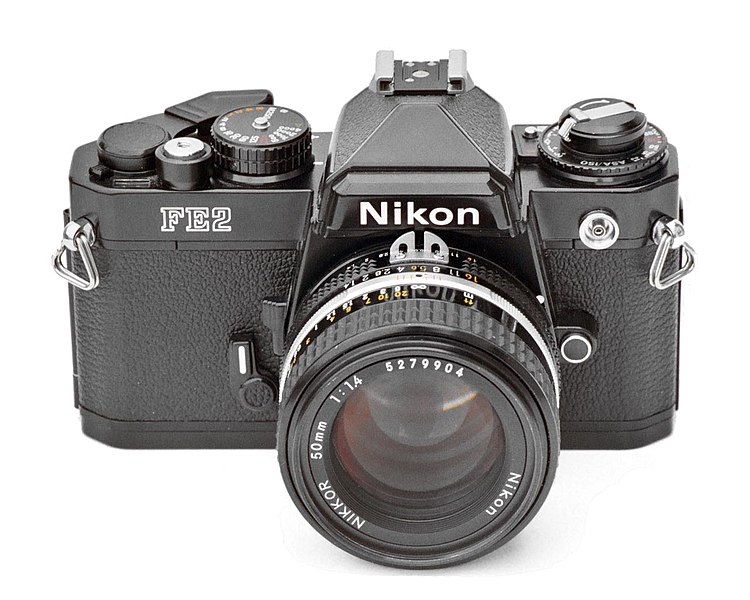
For the enthusiast or serious amateur, Nikon also released two other models in 1983. The FE2 was an improved version of their popular FE, featuring aperture-priority automatic and manual, but with a maximum shutter speed of 1/4000 second. This was made possible by a revolutionary shutter design first seen on the FM2 of the previous year, and the design also allowed flash to be used at a maximum speed of 1/250 second. (Most SLR cameras of the time were only able to use flash at a speed no greater than 1/60 second; a handful did go to 1/125 second). The rugged design of Nikons meant that even models such as the FE2 or FM2 found favour with professionals.
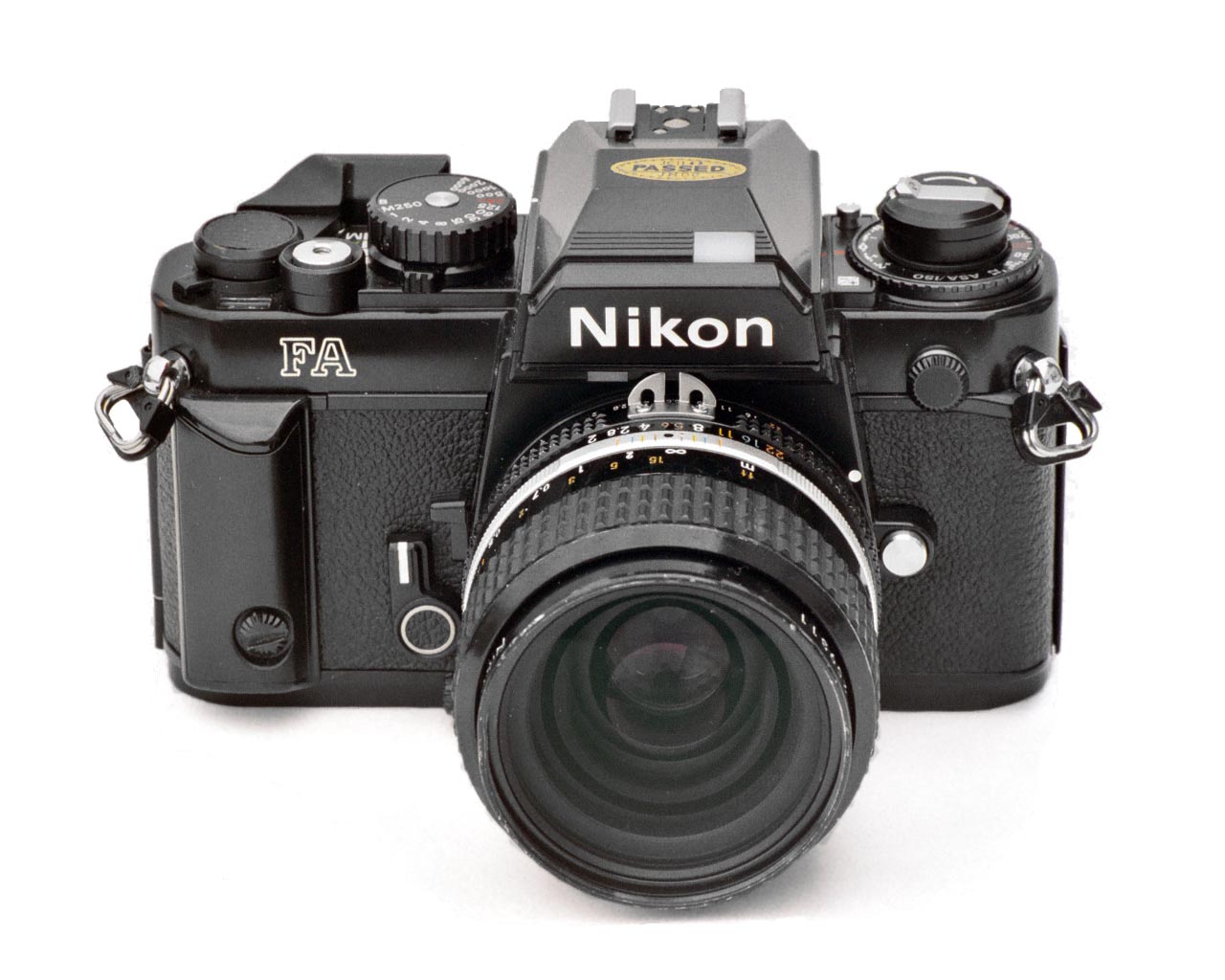
Their other model released that year was the FA, the company's first venture into 'multi-mode' SLR production. This sector of the market had been sewn up by rivals Canon for the five years previously, as their flagship A-1 camera sold by the lorryload. Multi-mode meant that the camera could be used in more than one automatic mode; aperture priority (the user sets the lens aperture while the camera selected the correct shutter speed), shutter-speed priority (the other way around), or programmed mode where the camera would calculate the exposure selecting both aperture and shutter speed. The FA also had a new trick up its sleeve; its metering system was extremely advanced for the time and could calculate the correct setting using different segments of the scene. This is known today as 'matrix' metering, and was revolutionary in 1983. Almost every modern camera made today uses a variation of this system.
Canon meanwhile had tried a different approach with their latest SLR models. The T-series of SLRs began in 1983 with the launch of the T-50; this model was aimed at the photographer who wanted a first SLR and came with programmed exposure only (no manual mode) and in addition to that, it had a built-in power winder. The T-50 was soon overshadowed by subsequent models; the T-70 offered more control while the later, ultra-sophisticated T-90 became a design classic.

Pentax were a very popular choice of camera brand for enthusiasts in the UK at this time thanks largely to their ME-Super model of 1980, one of the best-selling camera models of the day. The Super-A, released in 1983, took things a stage further, once again offering multi-mode exposure systems and with a push-button system of operation similar to that of the ME-Super, it appeared to be the logical upgrade for ME-Super users. However, to achieve the multi-mode functionality, it was necessary for Pentax to modify their lens mount, adding electronic contacts to be used with a new range of lenses. Although existing lenses lacking the contacts fitted the new model. it meant that existing Pentax users were unable to take advantage of the Super-A's new features. It still won European Camera of the Year however, and it was soon accompanied by a slightly cheaper model, the Program-A.

Pentax Super-A (Wikipedia)
Meanwhile, Olympus had finally unveiled two new flagship models intended to replace their ageing SLR line-up. Their manual OM-1 and automatic OM-2 had been in production since the early 1970s, and although revolutionary for their day, other makers had caught up with them and in some cases were overtaking them. The OM-4 of 1983 was intended to be the successor to the OM-2, still offering automatic and manual exposure, it also had the most sophisticated metering system yet seen on an SLR camera. In short, it was able to 'spot-meter' up to eight different points and work out the correct exposure from an average of these. In addition, it could also 'spot' the darkest or lightest part of a scene and adjust its setting accordingly. The innovation didn't end there; Olympus had licked the problem of flash with focal-plane shutters once and for all with their new flashgun designed specifically for the OM-4. This flashgun allowed operation at any shutter speed; SLR cameras had a maximum speed where the shutter would fully open, beyond that the shutter would only open partially, with a 'slit' of light moving quickly across the frame. The new flash, called 'Full Synchro' worked by firing a continuous burst of light all through the shutter's motion, so the image would be correctly lit across the whole frame. The camera was a sensation and remained in production until 2002, albeit in a revised form with a titanium body (and higher price to match). The OM-3 (the successor to the manual, mechanical OM-1) boasted the same metering and flash features but without the automatic exposure; produced in limited quantities this model is now a much sought-after collectors' item.

The last of the major SLR makers, Minolta, were still two years away from launching their autofocus SLR (the Maxxum 7000) which would change the photography scene for good. They had a multi-mode SLR out already (the X-700, released in 1982) and their X-570 was a lower-specification, lower-priced variation of that. They were very much the lesser lights of the photography scene back then, but their autofocus 7000 and 9000 models which came later in the decade changed all of that and caught their rivals napping.
Autofocus had arrived with compact cameras by this time, a popular model was Canon's 'Sure Shot' 35mm with motor wind and a built-in flash to go with its autofocus ability.

However, early attempts at bringing autofocus to SLR cameras were clunky efforts, with the mechanisms often built into specially-developed lenses, adding extra bulk. The Pentax ME-F and Olympus OM-30 were SLR models with the ability to 'confirm' correct focus with an indicator in the viewfinder, but needed such a special lens to offer true autofocus. Nikon also offered a variant of their professional F3, the F3AF, but this was a very specialist and expensive item. The real revolution came two years later, as described above.
In the snapshot market, Kodak had launched Disc film and a whole new range of cameras. This film came in a format resembling a computer disk, inside was a wheel containing 15 individual frames of film. The makers trumpeted this as an innovative design allowing for neater, smaller cameras, however the format flopped badly since the negatives it gave were a very tiny 11mm x 8mm. This meant considerable enlargement to give even small prints, and the results were unacceptable to most users. Kodak got away with this trick a few years earlier with 110 film, a small drop-in cartridge offering negatives of 17mm x 13mm (compared to 24mm x 36mm on a 35mm film negative), which meant they could sell less film for the same money. However, by the time of Disc, the consumer had wised up to that ploy.
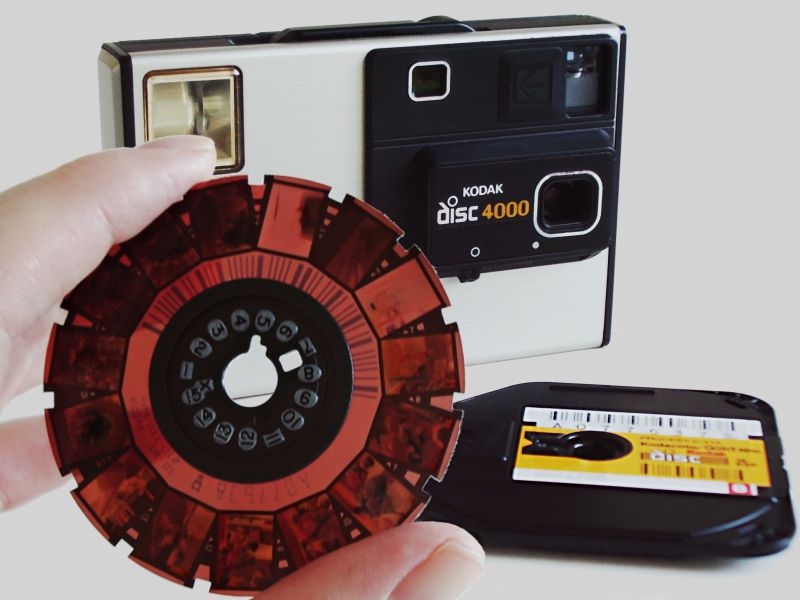
Kodak's short-lived Disc film and camera (Wikipedia)
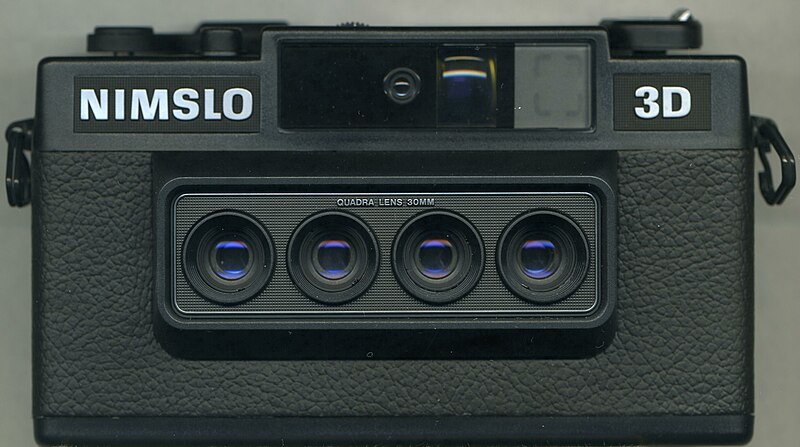
Another innovation which failed to catch on was 3D stereo photography. The Nimslo camera (with four lenses set alongside each other) was finally launched this year after a lot of hype, but although it took conventional 35mm film, the lack of photofinishers geared up to handle the printing of these snaps meant that the product bombed, and the company soon collapsed.
Lastly, in the movie camera market, the whole industry had shifted to video by this time as video maker JVC produced VHS-C, a cut-down version of the VHS tape format (which would play in a conventional VHS player via an adapter) making smaller camcorders possible. Rival Sony responded with Video 8, a small-format tape designed specifically for their camcorders. Camcorders all but killed off the cine camera, as the Super-8 cine film format passed into history. In years to come, digital still photography would do the same thing to conventional film cameras.

Subscribe to:
Posts (Atom)