Friday, 30 August 2013
1983 in television: Blockbusters starts and coins a catchphrase
A long-running game show made its UK debut in 1983, which eventually drew a large cult following and introduced a humorous catchphrase to the lexicon.
Blockbusters, hosted by veteran presenter Bob Holness, was based on an American format but it was the British version of the show which would run for longer. The premise was that a solo contestant would take on a team of two, in trying to complete a path of a game board consisting of hexagons, each with a letter. That letter would form the basis of the question which Holness would put to either side, and a successful answer won the hexagon. If the answer was wrong, the other side would get the chance to answer the question, win the hexagon and 'block' the path of their opponent. The team of two had the longer horizontal path across the board while the solo contestant would play vertically, the shorter route. The contestants were students, and Holness established himself as the older genial host. The humour often derived from a contestant requesting the hexagon containing the letter 'P', leading to the catchphrase "Can I Have A 'P' Please, Bob?".
The show ran for eleven years on ITV, and enjoyed its most successful period from about the late 1980s. Occasionally, the end credit sequence showed the studio audience performing the 'hand jive' to the theme music, something which became more frequent as it caught on in popularity.
The show eventually ended in 1994 after a short-lived move to satellite channel Sky One, but Bob Holness was indelibly associated with the programme for the remainder of his life. He died in January 2012 at the age of 83, and tributes to him inevitably focused on his time presenting 'Blockbusters'. Re-runs of the series are sometimes seen on UK satellite television today.
Here is the opening theme to 'Blockbusters' - hand jives optional!

Wednesday, 28 August 2013
Music of 1983: Manilow Blenheim Palace gig
A balladeer from New York City, Barry Manilow had scored a string of UK hits from around the mid-1970s and was undeniably popular, despite his career coinciding with the era of punk and new wave, and despite his style being shamelessly 'middle-of-the-road'. His audience was definitely that of the older demographic, but his consistent success illustrated sharply that the music charts didn't belong exclusively to teenagers.
As a consequence, he was derided as 'uncool' by pretty much anyone under 30 who considered themselves a music fan, but this didn't affect his record sales, or his concert attendances. By 1983, he was sufficiently big to stage a huge summer outdoor concert in the UK. The location was a unusual one: the grounds of Blenheim Palace, the ancestral home of the Duke of Marlborough was to be the setting. The Duke and Duchess were reportedly fans of Manilow themselves which made the arrangements possible.
An estimated 50,000 people attended the concert, and it was televised for transmission on BBC television. My memory of that transmission is that it seemed to be repeated over, and over again in a period of about six months following the concert! As a hard rock fan, and with only four TV channels to choose from at the time, that didn't go down at all well with my earlier self (!)
Manilow himself considered the concert to be a watershed moment, he hadn't realised just how big the audience was until later on in the show, when a sea of lighters, candles or torches were lit during one number. Overcome at the sight, he took a moment to compose himself.
Following this show he took some time away from the music scene; returning with an album more influenced by jazz rather than pop.
Barry Manilow is without doubt a 'Marmite' artist; someone you either love or hate. Whichever side you fall on, there was no doubt he was a hugely successful artist. If you've read this far, you are likely to actually watch the clip posted below! :D
____________________________________________________________________
Thursday, 22 August 2013
1983 in photography: popular cameras of the year
With photography being one of my passions in 1983 just as much as it is today, I thought I'd write about some of the developments (pun intended) in the photography world of 30 years ago. The period was one of intense competition between five major Japanese camera brands, as each tried to outdo the other with their flagship SLR (single-lens reflex) camera models. By 1983 however, SLR sales were starting to decline and makers were looking for new innovations to maintain their share of the market. The 35mm camera brand most favoured by professionals working in the field was Nikon, and their most recent professional model, the F3 had been released three years earlier to positive response. A variation on that model, the toughened-up F3/T (for 'titanium', used in its construction) was issued during 1983. Intended for use in extreme conditions where reliability was a must, it was available in black finish and also champagne coloured finish.
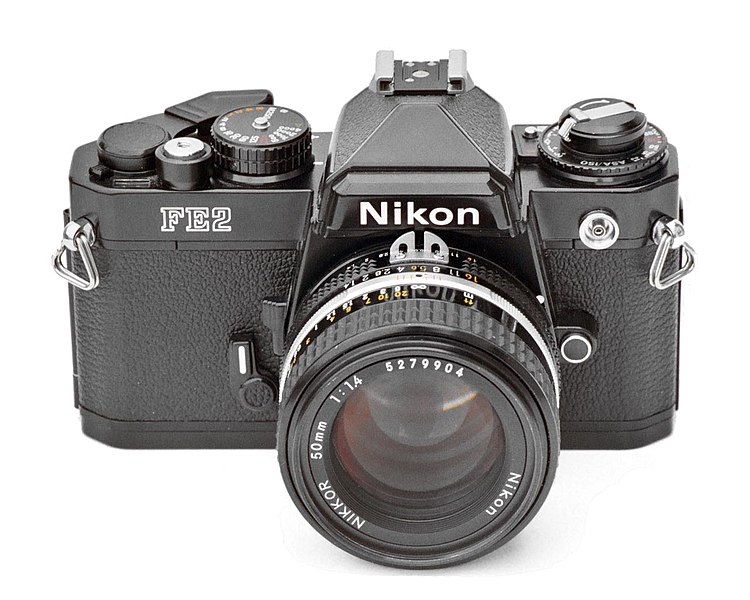
For the enthusiast or serious amateur, Nikon also released two other models in 1983. The FE2 was an improved version of their popular FE, featuring aperture-priority automatic and manual, but with a maximum shutter speed of 1/4000 second. This was made possible by a revolutionary shutter design first seen on the FM2 of the previous year, and the design also allowed flash to be used at a maximum speed of 1/250 second. (Most SLR cameras of the time were only able to use flash at a speed no greater than 1/60 second; a handful did go to 1/125 second). The rugged design of Nikons meant that even models such as the FE2 or FM2 found favour with professionals.
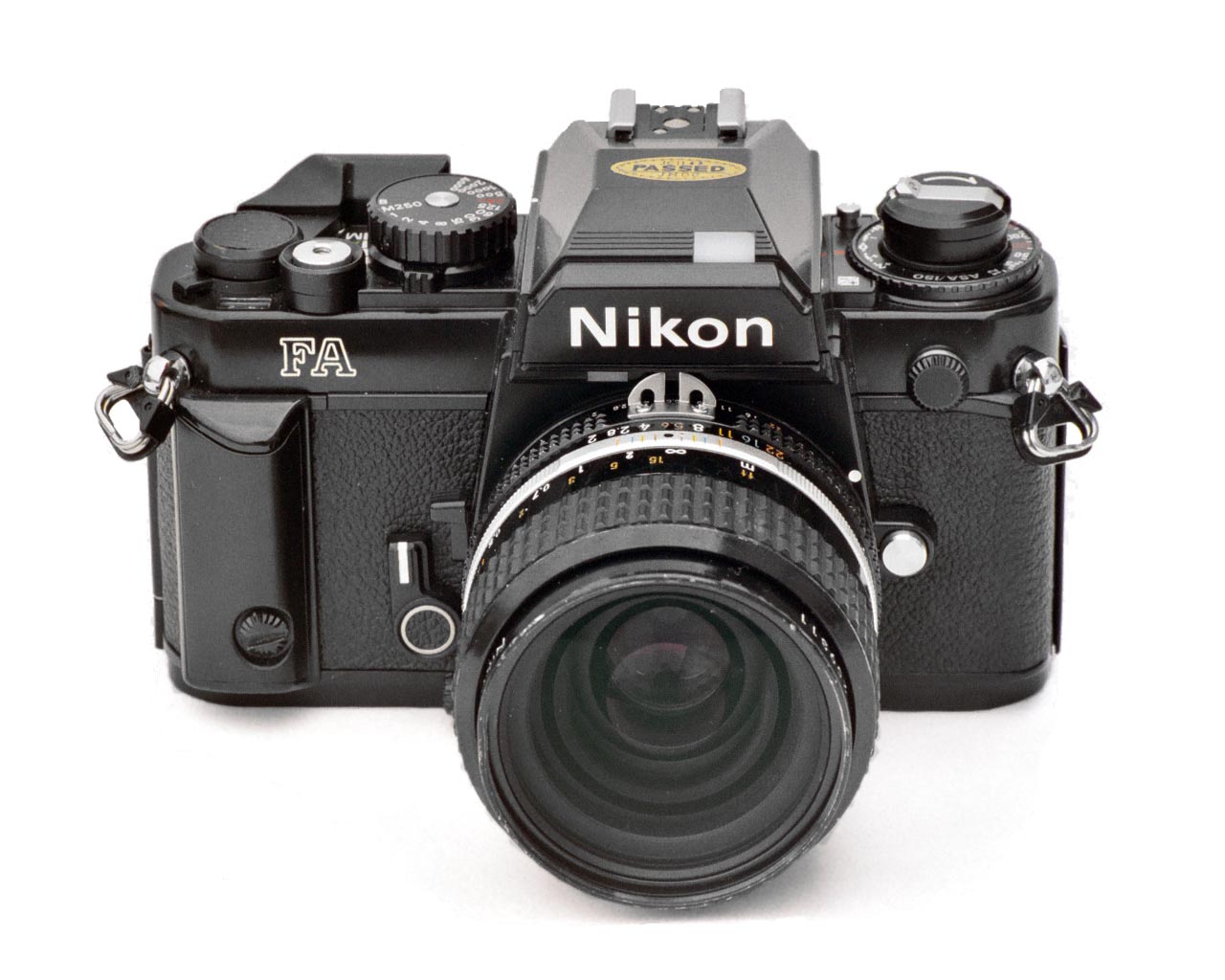
Their other model released that year was the FA, the company's first venture into 'multi-mode' SLR production. This sector of the market had been sewn up by rivals Canon for the five years previously, as their flagship A-1 camera sold by the lorryload. Multi-mode meant that the camera could be used in more than one automatic mode; aperture priority (the user sets the lens aperture while the camera selected the correct shutter speed), shutter-speed priority (the other way around), or programmed mode where the camera would calculate the exposure selecting both aperture and shutter speed. The FA also had a new trick up its sleeve; its metering system was extremely advanced for the time and could calculate the correct setting using different segments of the scene. This is known today as 'matrix' metering, and was revolutionary in 1983. Almost every modern camera made today uses a variation of this system.
Canon meanwhile had tried a different approach with their latest SLR models. The T-series of SLRs began in 1983 with the launch of the T-50; this model was aimed at the photographer who wanted a first SLR and came with programmed exposure only (no manual mode) and in addition to that, it had a built-in power winder. The T-50 was soon overshadowed by subsequent models; the T-70 offered more control while the later, ultra-sophisticated T-90 became a design classic.

Pentax were a very popular choice of camera brand for enthusiasts in the UK at this time thanks largely to their ME-Super model of 1980, one of the best-selling camera models of the day. The Super-A, released in 1983, took things a stage further, once again offering multi-mode exposure systems and with a push-button system of operation similar to that of the ME-Super, it appeared to be the logical upgrade for ME-Super users. However, to achieve the multi-mode functionality, it was necessary for Pentax to modify their lens mount, adding electronic contacts to be used with a new range of lenses. Although existing lenses lacking the contacts fitted the new model. it meant that existing Pentax users were unable to take advantage of the Super-A's new features. It still won European Camera of the Year however, and it was soon accompanied by a slightly cheaper model, the Program-A.

Pentax Super-A (Wikipedia)
Meanwhile, Olympus had finally unveiled two new flagship models intended to replace their ageing SLR line-up. Their manual OM-1 and automatic OM-2 had been in production since the early 1970s, and although revolutionary for their day, other makers had caught up with them and in some cases were overtaking them. The OM-4 of 1983 was intended to be the successor to the OM-2, still offering automatic and manual exposure, it also had the most sophisticated metering system yet seen on an SLR camera. In short, it was able to 'spot-meter' up to eight different points and work out the correct exposure from an average of these. In addition, it could also 'spot' the darkest or lightest part of a scene and adjust its setting accordingly. The innovation didn't end there; Olympus had licked the problem of flash with focal-plane shutters once and for all with their new flashgun designed specifically for the OM-4. This flashgun allowed operation at any shutter speed; SLR cameras had a maximum speed where the shutter would fully open, beyond that the shutter would only open partially, with a 'slit' of light moving quickly across the frame. The new flash, called 'Full Synchro' worked by firing a continuous burst of light all through the shutter's motion, so the image would be correctly lit across the whole frame. The camera was a sensation and remained in production until 2002, albeit in a revised form with a titanium body (and higher price to match). The OM-3 (the successor to the manual, mechanical OM-1) boasted the same metering and flash features but without the automatic exposure; produced in limited quantities this model is now a much sought-after collectors' item.

The last of the major SLR makers, Minolta, were still two years away from launching their autofocus SLR (the Maxxum 7000) which would change the photography scene for good. They had a multi-mode SLR out already (the X-700, released in 1982) and their X-570 was a lower-specification, lower-priced variation of that. They were very much the lesser lights of the photography scene back then, but their autofocus 7000 and 9000 models which came later in the decade changed all of that and caught their rivals napping.
Autofocus had arrived with compact cameras by this time, a popular model was Canon's 'Sure Shot' 35mm with motor wind and a built-in flash to go with its autofocus ability.

However, early attempts at bringing autofocus to SLR cameras were clunky efforts, with the mechanisms often built into specially-developed lenses, adding extra bulk. The Pentax ME-F and Olympus OM-30 were SLR models with the ability to 'confirm' correct focus with an indicator in the viewfinder, but needed such a special lens to offer true autofocus. Nikon also offered a variant of their professional F3, the F3AF, but this was a very specialist and expensive item. The real revolution came two years later, as described above.
In the snapshot market, Kodak had launched Disc film and a whole new range of cameras. This film came in a format resembling a computer disk, inside was a wheel containing 15 individual frames of film. The makers trumpeted this as an innovative design allowing for neater, smaller cameras, however the format flopped badly since the negatives it gave were a very tiny 11mm x 8mm. This meant considerable enlargement to give even small prints, and the results were unacceptable to most users. Kodak got away with this trick a few years earlier with 110 film, a small drop-in cartridge offering negatives of 17mm x 13mm (compared to 24mm x 36mm on a 35mm film negative), which meant they could sell less film for the same money. However, by the time of Disc, the consumer had wised up to that ploy.
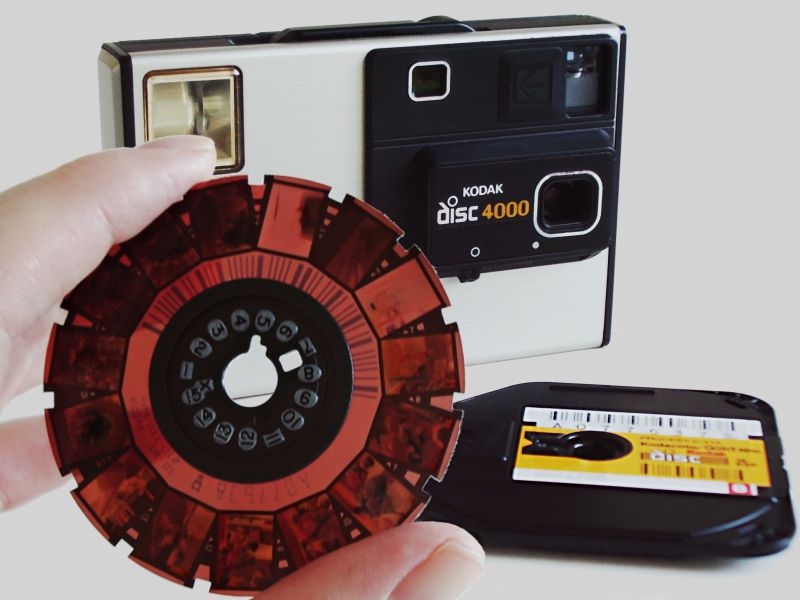
Kodak's short-lived Disc film and camera (Wikipedia)
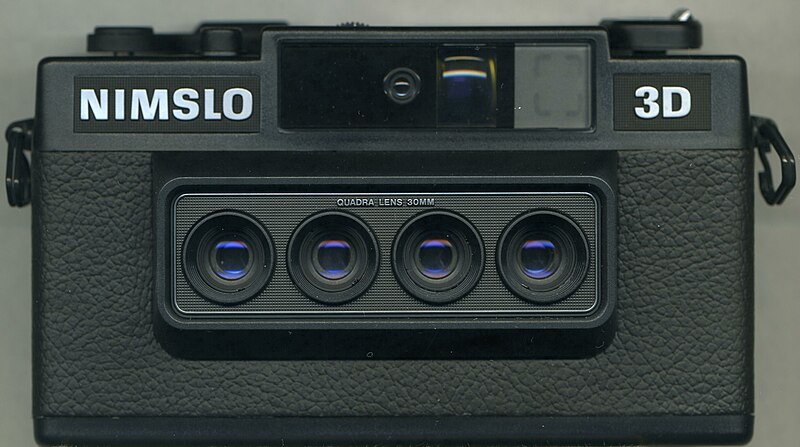
Another innovation which failed to catch on was 3D stereo photography. The Nimslo camera (with four lenses set alongside each other) was finally launched this year after a lot of hype, but although it took conventional 35mm film, the lack of photofinishers geared up to handle the printing of these snaps meant that the product bombed, and the company soon collapsed.
Lastly, in the movie camera market, the whole industry had shifted to video by this time as video maker JVC produced VHS-C, a cut-down version of the VHS tape format (which would play in a conventional VHS player via an adapter) making smaller camcorders possible. Rival Sony responded with Video 8, a small-format tape designed specifically for their camcorders. Camcorders all but killed off the cine camera, as the Super-8 cine film format passed into history. In years to come, digital still photography would do the same thing to conventional film cameras.

Tuesday, 20 August 2013
1983 in rock: Monsters of Rock festival
The Monsters of Rock festival, held at Donington Park, Leicestershire, England every summer had become a fixture in the rock fans' calendar since its inception in 1980. A one-day event featuring six or seven bands held in the centre of a motor racing circuit, it attracted star names such as Rainbow and AC/DC as headliners in the past. In 1983, the headliners were to be blues-rock stalwarts Whitesnake, topping a bill which aimed to mix old and new rock acts. Special guest was none other than Meat Loaf, who despite having gone on to make more music since his breakthrough album 'Bat Out Of Hell', was still strongly associated with that record. Texan blues-boogie masters ZZ Top were also on the bill, at the request of David Coverdale, along with up-and-coming shock rockers Twisted Sister. Rounding out the bill were Dio (who were making their debut UK appearance, having formed only months before) and openers Diamond Head, who had changed style somewhat with their 'Canterbury' album.
For me personally, this was a big event; only my second Monsters of Rock and the band I was looking forward to seeing the most was Dio. I'd become a big fan of Ronnie James Dio's work over the past year thanks to a friend who was a devotee, so much so he spent months tracking down some of RJD's more obscure work (these being the days when the Internet was a distant dream). With him having launched his own band in fine style that year with the 'Holy Diver' LP, the UK debut for his own band was eagerly anticipated.
My memories of the day are a little hazy now but I do remember only catching the end of Diamond Head, being more concerned with getting a spot to enjoy Dio's set. When they came on after a lengthy keyboard intro, and opened with 'Stand Up And Shout' off that 'Holy Diver' LP, something was immediately amiss. The guitar - where was it? Completely inaudible, the set got off the worst possible start as we could see, but not hear, axeman Vivian Campbell. The sound only began to straighten itself out after the second number, but somehow Ronnie James Dio held the whole thing together and that immense voice of his all but made up for the missing guitar. Once we could hear the whole band, it became a short but sweet run through of the choicest cuts from their album, plus a few oldies from his Rainbow and Black Sabbath days. They were only on stage for about 45 minutes, but arguably stole the day. Following this appearance the band returned to the UK in the autumn for a well-received tour.
Next up were Twisted Sister, a band who divided opinion mainly because of their outrageous appearance. Frontman Dee Snider gave short shrift to the infamous bottle-chuckers and after one rant where he offered to 'meet' anyone who cared to take him on personally, they settled and delivered a strong set. Snider, when not fronting up, was a strong vocalist and had to be, to follow Ronnie James Dio.
Things settled down for ZZ Top who delivered what I remember to be a chilled-out set, the highpoint of which was probably 'Tubesnake Boogie'. They hadn't quite broken through in this country yet, although 'Eliminator' was out by then, and it wasn't until two years later that they were big enough to headline this event themselves.
Meat Loaf was probably a bit too theatrical for this kind of event, though he gave a good performance, it didn't really go down that well with the audience who were by this time lobbing plastic bottles filled with dubious liquids everywhere. His set did lean heavily on 'Bat' despite having a new album 'Midnight At The Lost And Found' out at the time.
I've since become a big fan of Whitesnake, but 30 years ago was the first time I'd seen them at all. They had played here once before as special guests to AC/DC two years earlier, but by this time the classic line-up had splintered. David Coverdale had patched together a new line-up for this show and had been working on the 'Slide It In' album with producer Eddie Kramer. A single, 'Guilty Of Love' was rush-released to coincide with this show, and Coverdale's band comprised guitarist Micky Moody and keyboard player Jon Lord from the 'classic' band, with Cozy Powell coming in on drums, veteran blueser Colin 'Bomber' Hodgkinson on bass and former Trapeze guitarist Mel Galley completing the line-up. The latter had been working as a stagehand at this event 12 months previously; now he was part of the headline act.
Despite these changes to the personnel, it was still 'early' Whitesnake; the band adopted a quasi-military image for the occasion, styling themselves as 'Whitesnake Commandos', dressing in combats for the publicity photos and issuing T-shirts in khaki green with 'IV Donington Campaign '83' written in stencil-type lettering on the back. On stage however, it was jeans and T-shirts as usual. The set featured some of the older songs being played for the last time, including 'Lovehunter' and the Deep Purple classic 'Mistreated', and Coverdale is on record as having almost become overcome when the crowd took over 'Ain't No Love In The Heart Of The City'.
The set went over well, and was filmed for a later video release. Behind the scenes however, things were still tempestuous. Moody quit shortly after this show after a backstage dispute with Coverdale, and soon afterward 'Bomber' Hodgkinson followed suit. The album sessions they'd been working on with Eddie Kramer were completely discarded and Coverdale started afresh, recalling bassist Neil Murray to the ranks and recruiting hotshot guitarist John Sykes from Thin Lizzy. He also brought Martin Birch back to the producer's chair, but the turbulence caused a planned run of UK dates at the end of 1983 to be cancelled, and rescheduled for spring 1984.
It was only the beginning of a tempestuous period for Coverdale and his troops of course, which ultimately would lead to huge success across the pond, but that is something for a completely different article!
Here is Whitesnake with 'Ain't No Love In The Heart Of The City' from Donington 1983:
Whitesnake - Ain't no love in the heart of the... by trashking
Sunday, 18 August 2013
1983 in rock: Genesis show pretenders how to do prog with Mama
1983 was a vintage year for progressive rock, with a raft of newer bands spearheaded by Marillion picking up the gauntlet thrown down by the likes of Genesis, Yes and King Crimson a decade earlier. Both Yes and Genesis returned to the fray themselves that year and Genesis, by now slimmed down to a trio of Phil Collins, Mike Rutherford and Tony Banks (at least on record) released an album simply titled 'Genesis', which featured a typically 1980s cover design consisting of simple yellow block shapes.
Genesis had undergone a transformation in sound to go with their slimmed-down line-up; with shorter (and in some cases 'poppier' songs) and with modern synth sounds prominent, they were starting to lose some of their older fans who had been with them since Peter Gabriel was vocalist, as they also gained new fans on the back of the concurrent solo success of drummer/singer Phil Collins. Perhaps wanting to show that they still had it in them to do 'prog', the lead-off single was 'Mama', a song that started off with a haunting synth sound and steadily built into a huge production. The structure of the track was very similar to that of 'In The Air Tonight', the song that had kick-started Collins' solo career two years earlier and like that track, it had only a drum machine rather than actual drums until the closing segment, when a huge salvo kicked in. The drum sound had the same 'gated reverb' effect as 'In The Air Tonight', which Collins and producer Hugh Padgham had pioneered. This sound made the drums appear to 'explode' from the speakers with startling effect.
'Mama' was the band's biggest UK hit at the time, reaching number 4 in the charts and although subsequent singles were more in the shorter, poppier vein, they did have another prog trick up their sleeve on the album. 'Home By The Sea/Second Home By The Sea', a suite of two tracks written from the viewpoint of a burglar who finds himself a captive of ghosts, compelling him to hear their life stories... "as we relive our lives with what we tell you".
With 'Mama' and the 'Home By The Sea' suite, Genesis showed the new breed how to do progressive rock, and the album and subsequent tour (for which, they were augmented on stage by Daryl Steurmer on guitar or bass, and Chester Thompson on drums) proved to be a success, culminating in a run of dates at Birmingham's NEC arena the next year.
From the 1983 self-titled 'Genesis' album, here is 'Mama'.
Genesis had undergone a transformation in sound to go with their slimmed-down line-up; with shorter (and in some cases 'poppier' songs) and with modern synth sounds prominent, they were starting to lose some of their older fans who had been with them since Peter Gabriel was vocalist, as they also gained new fans on the back of the concurrent solo success of drummer/singer Phil Collins. Perhaps wanting to show that they still had it in them to do 'prog', the lead-off single was 'Mama', a song that started off with a haunting synth sound and steadily built into a huge production. The structure of the track was very similar to that of 'In The Air Tonight', the song that had kick-started Collins' solo career two years earlier and like that track, it had only a drum machine rather than actual drums until the closing segment, when a huge salvo kicked in. The drum sound had the same 'gated reverb' effect as 'In The Air Tonight', which Collins and producer Hugh Padgham had pioneered. This sound made the drums appear to 'explode' from the speakers with startling effect.
'Mama' was the band's biggest UK hit at the time, reaching number 4 in the charts and although subsequent singles were more in the shorter, poppier vein, they did have another prog trick up their sleeve on the album. 'Home By The Sea/Second Home By The Sea', a suite of two tracks written from the viewpoint of a burglar who finds himself a captive of ghosts, compelling him to hear their life stories... "as we relive our lives with what we tell you".
With 'Mama' and the 'Home By The Sea' suite, Genesis showed the new breed how to do progressive rock, and the album and subsequent tour (for which, they were augmented on stage by Daryl Steurmer on guitar or bass, and Chester Thompson on drums) proved to be a success, culminating in a run of dates at Birmingham's NEC arena the next year.
From the 1983 self-titled 'Genesis' album, here is 'Mama'.
Saturday, 10 August 2013
1983 in television: By The Sword Divided
The BBC has a long tradition of producing quality historical dramas, and another made its debut in 1983 when By The Sword Divided reached our screens. Set in the period leading up to, then during, the English Civil War, it served to show the impact of the war on the Lacey family, which became split with family members siding with either the Royalist, or Parlimentarian side.
The series boasted a strong cast including Julian Glover, Sharon Maughan (or Mughan as she was credited in the series), Gareth Thomas (of 'Blakes 7' fame) and Rosalie Crutchley. The first series, shown in 1983, covered the period to the end of the First English Civil War in 1646, whereupon the Royalist side was defeated. The series ran for two seasons and concluded with the Restoration of the Monarchy, illustrating throughout the shifting loyalties among the cast of characters.
By The Sword Divided has not been shown a lot on UK television since its original transmission between 1983 and 1985, but it has been issued on DVD in recent years.
Below is the first episode of 'By The Sword Divided':
Monday, 5 August 2013
1983 in music: Billy Joel scores big with 'An Innocent Man'
American singer-songwriter Billy Joel had a big year in 1983. Already well-known and with a string of radio hits to his name, his ninth album 'An Innocent Man' and lead-off single 'Uptown Girl' were huge hits, with both the album and Joel's performance on the 'Uptown Girl' single becoming nominated for Grammy awards. (Both lost out to Michael Jackson, unsurprisingly)
'An Innocent Man' spawned a string of hit singles, including 'Tell Her About It', 'The Longest Time' and the title track 'An Innocent Man'. The album spent over a year on the UK charts, while in his native US, the album spent a staggering 111 weeks on the US pop album charts.
Joel had become something of a fixture in celebrity gossip mags for his relationship with supermodel Christie Brinkley at this time; and she appeared in the now-iconic video for 'Uptown Girl' in which Joel plays a motor mechanic, while Brinkley is the well-heeled customer. The material on the album was inspired by 1960s soul and R&B music, which the singer himself said was because of his feeling somewhat like a teenager again following his recent divorce, and high-profile relationship with Brinkley.
The video was parodied 28 years later in the BBC series 'Ashes To Ashes'; set in that period it featured Gene Hunt (played by Philip Glenister) as the Joel character and his police colleagues as the mechanics, with Alex Drake (Keeley Hawes) as the Brinkley character. The parody proved popular and illustrated the enduring appeal of the song and video.
Billy Joel has made only three more pop albums since 'An Innocent Man', with the last ('River of Dreams') coming in 1993. He remains a big draw on the live circuit however, and continues to tour the world performing his hits.
Here is Billy Joel with 'Tell Her About It':
Bonus: the parody of 'Uptown Girl' taken from 'Ashes To Ashes' (BBC):
Subscribe to:
Posts (Atom)